
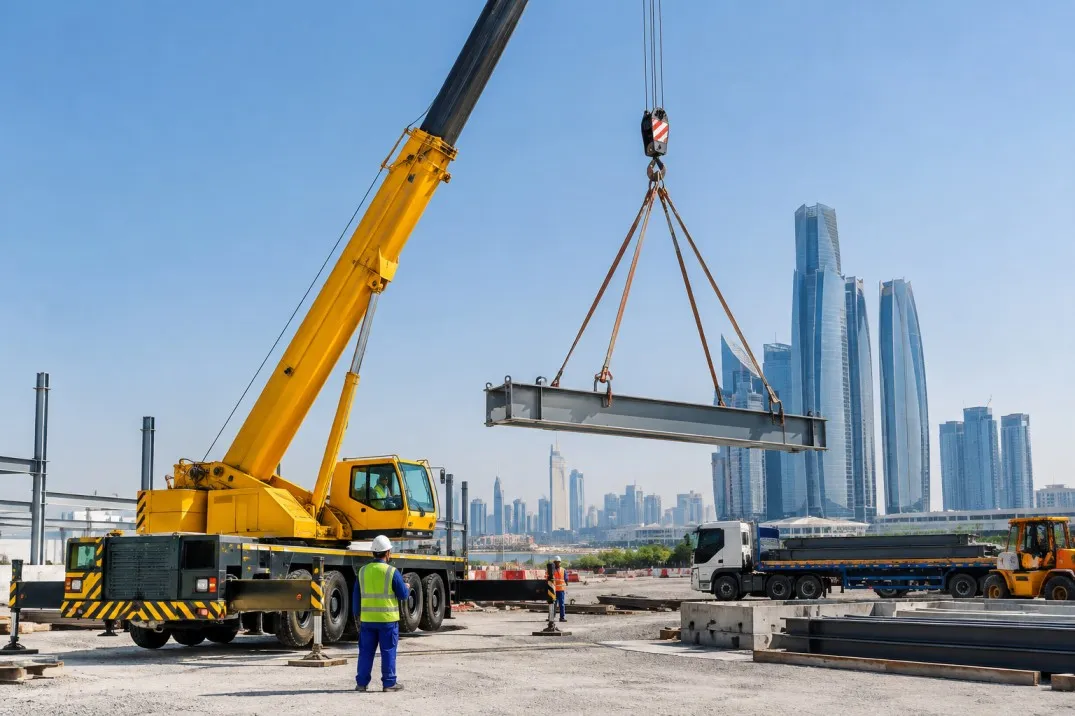
A lifting requirement rarely comes down to finding the biggest machine available. The useful question is what has to be lifted, where it has to move, how high it has to go, what the site allows, and how long the equipment will be needed. For contractors and industrial teams working in Abu Dhabi, those details shape the right rental choice.
Taineq provides lifting equipment rental Abu Dhabi solutions for construction, infrastructure, industrial, oil and gas, logistics, warehousing, plant maintenance, shutdowns and material-handling operations. Its current lifting range includes mobile cranes, manlifts, boom loaders and forklifts, with additional equipment assessed according to project requirements.
Before requesting a machine, define the task. A structural steel installation may call for a mobile crane, while upper-level material placement may suit a boom loader. A maintenance crew working above ground may need a manlift, whereas a warehouse team moving palletized materials needs a forklift.
This approach makes a rental enquiry more precise. Instead of asking only for a piece of equipment, provide the load weight, required height or reach, working area, access conditions, project location and expected rental period. Taineq states that equipment selection depends on factors including load weight, lifting height, working environment, site conditions, project duration and the type of work being performed.
Mobile cranes are suited to projects where heavy materials, structural components, machinery or equipment must be lifted and positioned. Taineq’s current service information describes applications including construction lifting, industrial equipment handling, structural steel installation, infrastructure work, heavy material lifting and plant or equipment movement.
For a crane enquiry, the useful starting information is the load, lifting radius, required height and site conditions. Taineq’s certified mobile crane page also describes pre-mobilisation lift-study support, including consideration of ground bearing capacity, outrigger footprint, pick-and-carry routes and clearances for complex lifts.
Manlifts are intended for work at height rather than simply moving heavy loads. They can support building maintenance, MEP installation, electrical and mechanical work, industrial maintenance, facility maintenance and high-level repair or installation tasks.
If the main requirement is getting personnel safely to an elevated work area, tell the rental team the working height, access limitations, work location and task. That information helps separate an access requirement from a conventional material-lifting requirement.
Boom loaders, also called telehandlers, combine a telescopic boom with hydraulic lifting capability. They are useful when materials need to be placed upward and forward, especially on multi-level or congested sites. Taineq lists applications such as upper-floor material placement, loading and unloading, reaching over obstacles, steel and prefabricated panel work, warehouse and yard handling, infrastructure work and oil and gas maintenance.
The current Taineq boom-loader page gives model-dependent reference figures of up to 17 metres lift height, up to 4,500 kg lift capacity and up to 13 metres forward reach, with attachment options including pallet forks, bucket, work platform and winch. These figures should be treated as model-dependent rather than as a universal specification for every available unit.
Forklifts are a practical choice when the job is primarily moving, loading, unloading and positioning materials. Taineq identifies warehouse operations, construction sites, industrial facilities and logistics or distribution work as applications for its forklift rental solutions.
When asking for a forklift, specify the material to be handled, approximate load, required lift height, working surface and access constraints. These details are more useful than simply requesting a forklift without describing the task.
The first two figures to establish are the load and the required height or reach. A machine must be suitable for the actual lift rather than selected only by general equipment category. For cranes, radius and height can materially affect the required configuration; for telehandlers, forward reach and lift height are equally important.
Site conditions influence equipment choice. Consider available working space, access routes, ground conditions, overhead restrictions, obstacles, traffic movement and whether the equipment must work indoors, outdoors or across changing terrain. For a crane, ground bearing and outrigger space can be important planning considerations; for a boom loader or forklift, access and turning space can influence practicality.
The same machine category can serve different tasks when configured appropriately. Taineq’s boom loaders can be supplied with different attachments depending on the application, while its excavator and broader equipment pages show that attachment choice can be part of the rental discussion. State the actual task so the equipment can be matched to the work rather than to a generic category.
Rental duration should be clear from the beginning. Taineq’s lifting service supports short-term requirements as well as longer operations, subject to equipment availability and project needs. The company also states that equipment can be supplied with professional support, while its certified crane page describes trained and licensed operators for mobile crane services.
Construction and infrastructure work can involve structural steel, precast elements, machinery, materials, MEP installation and equipment movement. Taineq’s lifting service is positioned for construction, civil engineering and infrastructure requirements across Abu Dhabi. The equipment choice should follow the specific lifting or access task at each project phase.
Industrial facilities, oil and gas operations, plant maintenance and shutdowns can create temporary or changing lifting requirements. Taineq lists industrial construction, plant maintenance, oil and gas operations, shutdown and turnaround projects, equipment installation and heavy material handling among the applications supported by its lifting service.
Warehouses and logistics operations often need material movement, loading and unloading, while facility maintenance may require elevated access. This is where forklifts and manlifts can address different operational needs without treating every requirement as a crane job.
A clear enquiry can reduce back-and-forth and make equipment matching easier. Include:
For more complex crane work, also provide the lift radius and height requirements. Taineq’s certified crane process describes using these details to recommend crane capacity and confirm availability before quoting.
The more precise the project brief, the easier it is to discuss a suitable machine, mobilisation plan and rental arrangement.
Taineq’s current lifting service is built around project-specific equipment selection rather than a one-size-fits-all rental approach. Its service page identifies construction, infrastructure, industrial, oil and gas, logistics, warehousing, plant maintenance, government and material-handling applications.
The company is based in Musaffah, Abu Dhabi, and its website states that it supports equipment rental requirements across Abu Dhabi and the wider UAE, subject to equipment availability and project location.
For certified mobile crane requirements, Taineq’s dedicated page describes third-party inspection certificates, operator documentation, flexible hire durations and pre-mobilisation planning support.
For boom-loader work, its dedicated page describes inspected machines, attachment flexibility, operator support and deployment from its Musaffah base.
If your project requires lifting, material handling or elevated access, share the task, load, height, site conditions and rental period with Taineq so the appropriate equipment can be discussed. The company lists its Abu Dhabi contact details as +(971) 52 7264909, +(971) 2 5643909 and rafeeq@taineq.com.
1. What lifting equipment can I rent in Abu Dhabi?
Taineq’s lifting service covers mobile cranes, manlifts, boom loaders and forklifts, with other lifting and material-handling equipment considered according to project requirements and availability.
2. How do I choose the right lifting equipment for my project?
Start with the load weight, lifting or working height, reach, site conditions, access, task type and rental duration. These details help determine which equipment category is appropriate.
3. Can I rent lifting equipment for a short project?
Yes. Taineq states that lifting equipment can be rented for short-term requirements as well as longer operations, subject to equipment availability and project needs.
4. Can lifting equipment be supplied with an operator?
Operator support is available for relevant equipment. Taineq’s certified mobile crane page states that mobile crane units can be supplied with trained, licensed operators.
5. What information should I provide when requesting a quote?
Provide the site location, task, load weight and dimensions, required height or reach, site conditions, rental period, start date and whether an operator is required.
Reliable Equipment. Exceptional Service.