How Much Can a 50 Ton Crane Lift? Load Charts Explained
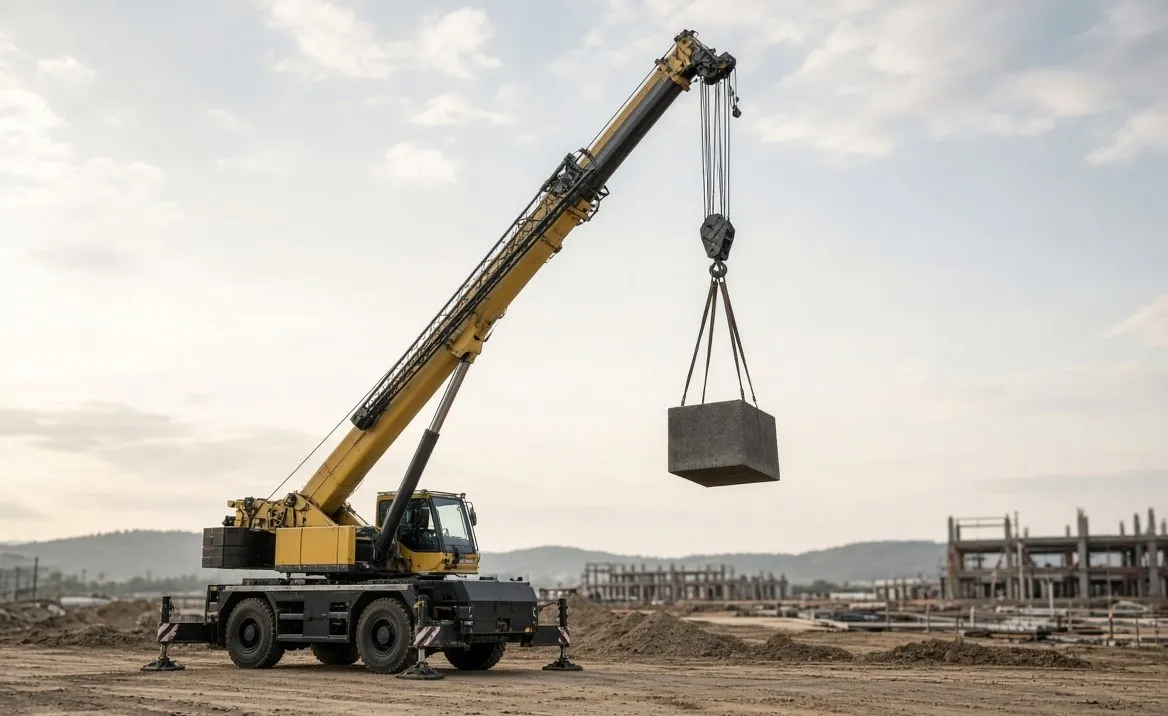
A 50 ton crane lift reaches 50 tons only with the boom short and the load close to the crane. On a Tadano 50 ton rough terrain crane, capacity drops from 45.4 metric tonnes at 3 metres radius to 1.4 tonnes at 30 metres. Taineq, Musaffah, Abu Dhabi, quotes every job from the crane load chart.
Most 50 ton cranes print their figures in pounds, so convert first: 50 US tons equals 45.4 metric tonnes. Every number below comes from the published Tadano GR500XL-1 rated lifting chart with outriggers fully extended to a 22 ft 11 in (7.0 m) spread.
What does 50 ton mean on a crane load chart?
The 50 ton label is the best case, not the daily case. The Tadano chart shows 100,000 lb (45.4 t) at a 10 ft (3 m) radius on the shortest 33.5 ft boom. Move the load out to 20 ft (6.1 m) on that boom and the crane load chart falls to 52,700 lb (23.9 t). Three extra metres of radius took away nearly half the capacity.
Radius is the horizontal distance from the crane centre of rotation to the hook. It is not the boom length. A 21.6 m boom raised steeply can still have a short radius, and that is the setup that keeps capacity high. Always check the chart header for the crane model and outrigger spread, because a figure from a different model will not match your crane.
At the other end, the same crane on its 108.3 ft (33 m) boom is rated for 3,150 lb (1.4 t) at a 100 ft (30.5 m) radius. Same machine, same label, about 32 times less capacity. A 50 ton crane lift is never planned from the number on the cab door.
What are Taineq crane sizes, capacity and rates?
This is how Taineq prices and specifies the sizes booked most often for building and plant work in Abu Dhabi.
| Crane size | Capacity and reach | Taineq rate per day | Included | Charged extra |
|---|---|---|---|---|
| 25 ton | 25 t rated. Reach per model chart | AED [add rate] | Licensed operator, load test certificate, chart check, mobilisation | Jib, auxiliary hoist, overtime |
| 50 ton | 45.4 t at 3 m, 23.9 t at 6.1 m, 1.4 t at 30.5 m on the 33 m boom | AED [add rate] | Licensed operator, load test certificate, chart check, mobilisation | Jib, auxiliary hoist, overtime |
| 75 ton | 75 t rated. Reach per model chart | AED [add rate] | Licensed operator, load test certificate, chart check, mobilisation | Jib, auxiliary hoist, overtime |
| 100 ton | 100 t rated. Reach per model chart | AED [add rate] | Licensed operator, load test certificate, chart check, mobilisation | Jib, auxiliary hoist, overtime |
Rates are per day. The 50 ton row uses the crane load chart figures above, so you can see what the crane does at each reach before you pay for it.
How do you read a crane load chart step by step?
Our operators in Musaffah follow this order before a crane leaves the yard. A correct crane load chart reading takes five steps.
- Match the chart to the setup. Outrigger spread changes the numbers. At 25 ft radius on the 33.5 ft boom, the Tadano is rated for 36,500 lb at the full spread and 24,500 lb at the 16 ft 5 in (5.0 m) spread. That is a one third loss from tighter outriggers alone.
- Measure the radius. Take it from the centre of rotation to the load, not along the boom. Boom deflection under load adds a little radius, and the Tadano notes tell operators to allow for it.
- Cross the boom column with the radius row. The cell is the gross rating.
- Subtract everything below the boom tip. That means hook block, slings and shackles. A 28.9 ft jib takes 4,700 lb (2.1 t) off the main boom rating, and a 50 ft jib takes 6,600 lb (3.0 t).
- Compare with the real load. Use the weight from the drawing or the weighbridge ticket, then leave a margin.
Worked example. A 14 tonne precast beam sits 6 m from the crane, and the plan calls for a 21.6 m boom. The chart gives 36,400 lb, about 16.5 t. Hook block and slings of 1.2 t leave 15.3 t net, so the beam uses 91 percent of what remains. That lift passes on paper and feels tight on site. A common site rule treats anything above 75 percent of chart capacity as a critical lift, which means a written lift plan and a briefing. We would shorten the radius or move up to a 75 ton unit.
What pulls a 50 ton crane lift below the chart figure?
The crane load chart is a ceiling set under ideal conditions. Five things pull the working figure down:
- Wind. The Tadano notes call for reduced capacity and shorter boom once wind passes 20 mph (9 m/s). Shamal days around Abu Dhabi can reach that.
- Ground. The chart assumes level, firm ground. SANY guidance puts a 3 degree slope at 15 to 20 percent below the chart value. Soft fill in yards needs outrigger mats.
- Line pull. The main winch is limited to 11,500 lb per line. With four parts of line the hook load caps at 46,000 lb (20.9 t), whatever the boom rating says.
- Side loads. Ratings cover freely hanging loads only. Dragging, side pull and sudden stops are outside the chart.
- Working on rubber. On rubber ratings sit at 75 percent of tipping load, against 85 percent on outriggers, so the numbers are lower again.
When is a 50 ton crane no longer enough?
Step up when the load passes about 75 percent of the chart value at your radius, or when a heavy pick sits beyond 18 m. At 60 ft (18 m) the Tadano chart shows roughly 10,000 lb (4.5 t). A 6 tonne chiller at that reach needs a bigger machine. Taineq runs telescopic cranes from 25 to 500 tonnes, so the change is a different unit, not a different supplier.
For sand, gravel and unprepared ground, our rough terrain crane rental units carry the same chart discipline. Every crane has current load test certificates, a load moment indicator and anti two block protection, and our crews work to ADNOC, CICPA and CNIA site requirements.
To book, send the lift weight, radius and height. Our team checks them against the crane load chart and confirms the crane, then you can request mobile crane rental in Abu Dhabi with a fixed quote.
FAQs
1. How much weight can a 50 ton crane lift?
Up to 45.4 metric tonnes (100,000 lb) at a 3 m radius, with the shortest boom and outriggers fully extended. At 6.1 m the same crane is rated for 23.9 tonnes, and at 30.5 m on the longest boom it drops to 1.4 tonnes. The crane load chart for your exact crane and setup gives the working figure.
2. How do you read a crane load chart?
Pick the chart that matches the outrigger spread and counterweight. Find the boom length column and the radius row, then read the rating where they cross. Subtract the hook block, slings and any jib, and compare what is left with the load weight plus a margin.
3. What does the bold line on a crane load chart mean?
Ratings above the bold line are limited by the crane structure. Ratings below it are limited by stability, which means tipping risk. The Tadano operating notes state this directly, and it is why you never stretch a rating that sits below the line.
4. How much does it cost to hire a 50 ton crane in Abu Dhabi?
Taineq quotes a 50 ton crane at AED [add rate] per day with a licensed operator and certificates. The final price moves with hire length, jib use and site access. Send the lift weight, radius and height and we return a fixed quote.
5. Does wind change a crane load chart?
The chart assumes calm air. The Tadano notes say rated capacity and boom length must be reduced once wind passes 20 mph (9 m/s). Large flat loads such as cladding panels catch the wind earlier, so operators stop those lifts at lower speeds.