Selecting the Right Crane Capacity for High-Rise Construction in Downtown Dubai
Downtown Dubai represents one of the most demanding high-rise construction environments globally. Flanked by Sheikh Mohammed bin Rashid Boulevard and Financial Center Road, skyscraper developments operate within tightly constrained plot boundaries, adjacent to operational metro lines, high-density commercial towers, and active public thoroughfares. In this environment, crane capacity selection is not merely a purchasing line-item; it is a high-stakes structural engineering decision. Sourcing machinery through professional construction equipment rental Dubai services allows engineers to deploy purpose-built climbing and luffing cranes designed specifically for dense urban profiles.
The “Nominal Capacity” Trap
A common mistake in tower crane specification is relying on gross manufacturer ratings. A crane marketed as a “100-tonne tower crane” only achieves that maximum load under ideal ground-level conditions at a minimal radius (typically within 12 to 15 meters from the mast center). When evaluating options for construction equipment rental Dubai, site managers must look far beyond standard promotional brochures. At working heights exceeding 200 to 500 meters, nominal capacity degrades substantially due to geometric, mechanical, and environmental forces.
Key Technical Takeaway: Nominal vs. Effective Net Capacity
Nominal capacity reflects static hook load at minimum radius under zero wind and ambient temperature standards. Effective net capacity is the real-world payload capacity remaining after deducting unspooled hoist wire rope mass, hook block tare weight, rigging gear, dynamic amplification factors, and high-altitude thermal derating.
Physics at Elevation: Net vs. Gross Lifting Capacity
As building heights cross 150 meters, the weight of the crane’s own hoisting equipment becomes a major portion of the total suspended load. Ignoring cable tare weight in load calculations leads directly to dangerous overloading of the winch drive and main structural jib.
The Steel Wire Rope Mass Tax
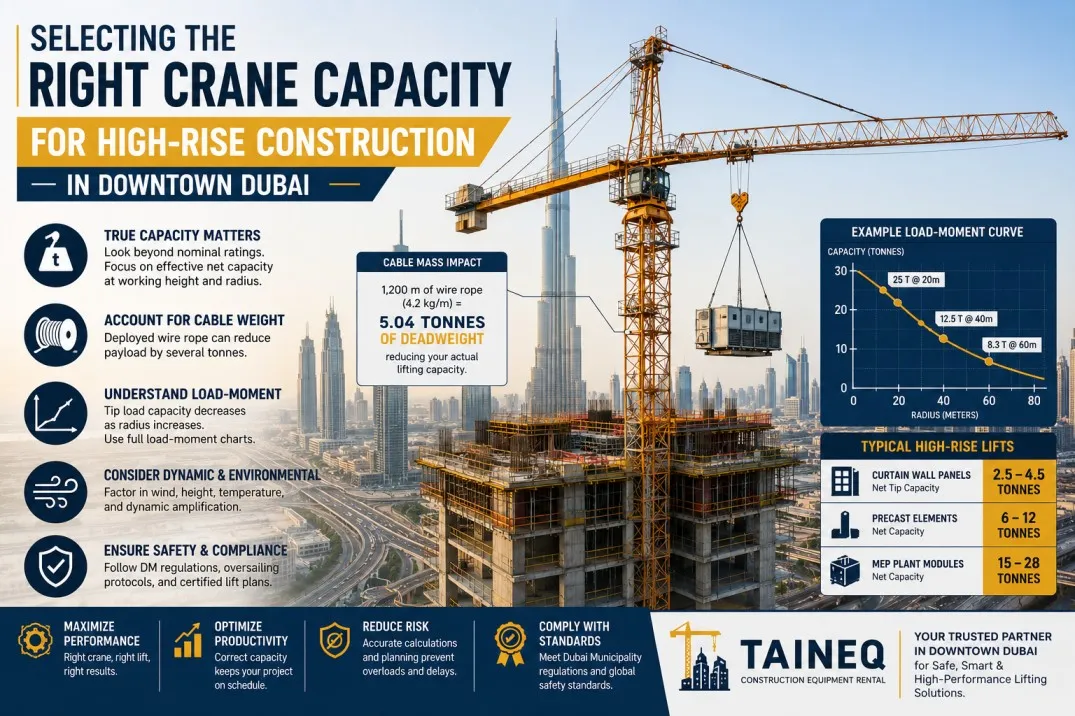
High-rise tower cranes utilize anti-twist rotation-resistant steel wire ropes ranging from 13.8 mm to 28 mm in diameter, weighing between 1.8 kg and 4.2 kg per linear meter. For a skyscraper with a hook height of 300 meters operating on a 4-fall reeving configuration, the total deployed cable length reaches 1,200 meters. The wire rope mass alone equals:
- Cable Mass Calculation: 1,200 meters × 4.2 kg/m = 5,040 kg (5.04 tonnes) of pure deadweight. DOCX
This 5.04-tonne deadweight hangs directly from the jib tip. Every kilogram of deployed cable reduces the crane’s allowable hook payload kilogram-for-kilogram. Engineers consulting with top-tier construction equipment rental Dubai specialists calculate the hook mass and cable tare at maximum hook depth before approving any lift plan.
Systematic Net Capacity Formula
To establish the true allowable payload at elevation, lifting engineers apply the following net capacity deduction formula:
DOCXNet Payload Capacity=Chart Gross Capacity−[Hook Block Mass+Rigging Tare Mass+(Deployed Cable Length×Cable Unit Mass)]
Engineering Directive: Leading equipment specialists incorporate unspooled cable mass into dynamic load monitoring systems (LMI) to automatically derate capacity as the hook lowers.
Kinematics & Reach: Tip Load vs. Peak Capacity
Tower crane selection must be driven by load-moment curves rather than isolated weight numbers. The governing metric in skyscraper construction is Tip Load Capacity—the maximum safe lifting weight at the crane’s furthest horizontal radius.
Load-Moment Mechanics
Load moment is expressed in Tonne-Meters (t⋅m), representing the structural torque applied to the crane mast:
Load Moment (t⋅m)=Suspended Mass (tonnes)×Operating Radius (meters)
A crane with a peak moment rating of 500 t⋅m can lift 25 tonnes at a 20-meter radius (25×20=500 t⋅m). However, at a 60-meter maximum jib reach, that same crane’s chart capacity drops to approximately 8.3 tonnes. Contractors partnering with Taineq for construction equipment rental Dubai receive comprehensive load-moment charts that plot exact payload limits across every meter of jib reach.
Sizing for High-Rise Envelope Elements
In Downtown Dubai, high-rise construction schedules depend on rapid façade installation and heavy plant positioning. Crane capacity must be calibrated against critical edge loads:
- Curtain Wall Panels: Unitized glass and aluminum frames hoisted at maximum radius require 2.5 to 4.5 tonnes of net tip capacity. DOCX
- Precast Concrete Elements: Architectural spandrels and structural edge beams weigh between 6.0 and 12.0 tonnes, requiring high mid-jib moment capacity. DOCX
- MEP Plant Modules: Chillers, transformers, and emergency generators hoisted to mechanical refuge floors weigh between 15.0 and 28.0 tonnes. DOCX
Dynamic Amplification Factor (DAF) & Drum Layer Derating
High-speed hoisting over long vertical drops introduces dynamic bouncing forces caused by cable elasticity and braking deceleration. Lifting engineers multiply static payload mass by a Dynamic Amplification Factor (DAF) ranging from 1.15 to 1.30:
Design Dynamic Load=Static Weight×DAF (1.15 to 1.30)
Additionally, as wire rope spools across multiple layers on the winch drum at extreme heights, the effective drum diameter increases. This increases the motor torque arm, reducing line pull force by 5% to 8% per additional rope layer. Advanced fleets available through construction equipment rental Dubai feature high-speed frequency-controlled winches with multi-layer drum groove compensation to preserve line pull.
Urban Constraints & Oversailing Protocols
Downtown Dubai features strict boundary management regulations enforced by Dubai Municipality (DM) and master developers like Emaar. Standard horizontal saddle-jib (hammerhead or flat-top) tower cranes present significant legal and physical hurdles in dense urban clusters.
The Prohibition of Oversailing
Under Dubai Municipality Construction Safety Code, a crane jib is strictly prohibited from swinging over adjacent property boundaries, occupied residential or office buildings, live vehicular lanes, or Dubai Metro elevated tracks without explicit third-party land-use permits. In tightly packed Downtown sectors, a 60-meter horizontal saddle jib will inevitably cross neighbor property lines during 360-degree slewing.
Luffing Jib vs. Saddle Jib Selection
To overcome oversailing restrictions, luffing jib tower cranes are mandatory for most Downtown high-rise sites. A luffing crane uses an inclined boom that can be raised from a near-horizontal position (15°) to an almost vertical angle (85°).
- Steep Incline Steepening: Reduces the out-of-service working radius from 60 meters down to less than 10 meters, keeping the jib entirely within plot limits. DOCX
- Clustered Multi-Crane Operation: Allows multiple tower cranes to be erected on adjacent building cores without collision risks. DOCX
- Dynamic Capacity Shift: As the luffing boom steepens, the operating radius decreases, naturally increasing the crane’s lifting capacity according to its load chart. DOCX
Experienced firms offering construction equipment rental Dubai specialize in luffing jib deployment, providing precise slewing limit switches and 3D anti-collision system integration.
Environmental Micro-Climates & Thermal Derating
Dubai’s climate presents extreme operational challenges—specifically high-altitude wind shear along coastal thermal corridors and intense ambient heat during summer months.
High-Altitude Wind Velocity Scaling
Wind speed increases significantly with elevation above ground level. According to wind engineering standards, velocity scales logarithmically:
Vz=V10×(10z)α
Where V10 is ground-level wind speed (at 10m), z is hook elevation, and α is the urban terrain roughness coefficient (0.22 for city centers). A manageable 25 km/h wind at ground level escalates to over 42 km/h at a height of 300 meters.
- Standard Lifting Cut-off: Operations halt when wind speeds reach 14 m/s (approx. 50 km/h). DOCX
- Façade Panel Cut-off: Façade & Large Sail-Area Panels: Lifting cut-off drops to 10 m/s (36 km/h) due to wind drag forces acting on broad panel surfaces. DOCX
UAE Ambient Heat Derating (45°C to 50°C)
During summer peak months, ambient temperatures in Downtown Dubai routinely exceed 45°C, with direct metal surface temperatures surpassing 65°C on crane superstructures. Continuous heavy lifting on multi-shift concrete pour schedules leads to:
- Hydraulic Fluid Degradation: High temperatures reduce oil viscosity, leading to thermal bypass trips in hydraulic luffing rams. DOCX
- Motor Duty-Cycle Derating: Electric hoist motors experience thermal overload if operated continuously at maximum line pull. DOCX
Specialized suppliers of construction equipment rental Dubai equip machinery with heavy-duty oil chillers, thermal motor insulation, and forced-air electrical cabinet cooling to prevent thermal shutdowns during continuous summer pours.
Structural Integration: Tie-Ins, Floor-Climbing & Base Reactions
As a skyscraper grows vertically, the tower crane cannot remain free-standing. Structural tie-in ties or internal floor-climbing frames must transfer immense horizontal reactions into the building core.
External Tied-In Cranes vs. Internal Floor-Climbing Systems
Contractors must select between two primary high-rise mounting configurations:
- External Tied-In Configuration: The crane mast stands outside the building profile and connects to the core walls via steel collar ties at 30 to 45-meter vertical intervals. Advantage: Continuous hoisting height. Disadvantage: Requires extensive collar tie fabrication and core wall structural anchoring. DOCX+ 2
- Internal Floor-Climbing Configuration: The crane sits inside an elevator shaft or mechanical opening and climbs upward floor-by-floor using hydraulic climbing collars. Advantage: No external tie-ins required; lower overall mast height needed. Disadvantage: Blocks elevator shaft fit-out and requires floor slab structural reinforcement. DOCX+ 2
Dynamic Tie-In Reaction Forces
Tie-in collars exert severe push-pull force vectors (Fx,Fy) and torsional moments (Mz) onto concrete shear walls. During peak wind conditions or maximum slewing deceleration, horizontal collar reaction forces can exceed 350 to 600 kN. Coordinating tie-in loads with structural consultants is mandatory to ensure concrete compressive strength reaches at least fck≥45 MPa before attaching tie collar pins. Partnering with expert technical teams in construction equipment rental Dubai ensures early structural coordination with project consultants.
Ground Bearing Pressure (GBP) Over Basement Slabs
Erecting or dismantling high-rise tower cranes requires heavy mobile assist cranes (350 to 500-tonne capacity) stationed on podium levels or suspended basement parking decks. Ground Bearing Pressure (GBP) under outrigger pads can exceed 180 to 250 kN/m². During mobile crane assembly, reputable construction equipment rental Dubai providers perform full mat-loading assessments and specify back-propping schedules across multi-level underground parking slabs.
Dubai Compliance, Permits & Mobilization Operations
Operating high-reach lifting equipment in Downtown Dubai requires rigorous statutory approvals and night-time mobilization logistics.
Regulatory Authorities & Certification
All lifting machinery must comply with the Dubai Municipality Code of Construction Safety Practice and undergo annual third-party inspection by LEEA-accredited (Lifting Equipment Engineers Association) certification bodies. Cranes exceeding 90 meters in height must obtain Dubai Civil Aviation Authority (DCAA) airspace clearance and feature high-intensity medium-red LED obstruction beacons and automatic light-sensor monitoring.
RTA Road Closure Logistics & Night Mobilization
Delivery of heavy mast sections, counterweights, and assist cranes requires Roads and Transport Authority (RTA) permits for oversized cargo transport. Mobilization along Financial Center Road or Sheikh Mohammed bin Rashid Blvd is restricted to low-traffic night windows (typically 1:00 AM to 5:30 AM). Working with certified providers of construction equipment rental Dubai streamlines compliance, permitting, and night logistics coordination.
Dismantling Strategy Built-In From Day One
A frequent oversight in skyscraper planning is failing to plan for crane removal. Once the building tops out, the primary tower crane cannot dismantle itself. Lifting engineers specify a secondary rooftop recovery crane (derrick crane) in the initial plan. The recovery crane lowers the main crane sections to the ground, and is then itself dismantled into small component pieces capable of fitting inside the building’s service elevator.
High-Rise Crane Selection Matrix
Choosing the optimal tower configuration from a construction equipment rental Dubai fleet requires balancing vertical height, reach radius, payload requirements, and site boundary constraints. The selection matrix below outlines engineering rules of thumb:
| High-Rise Parameter | Technical Factor | Impact on Crane Sizing | Engineering Selection Rule |
|---|---|---|---|
| Hook Height > 200m DOCX | Hoist rope mass tax (1.8 – 4.2 kg/m) DOCX | Reduces net payload capacity by 3 to 6 tonnes DOCX | Deduct wire rope mass from gross load chart; specify high-speed 2-fall reeving. DOCX |
| Tight Plot Boundary DOCX | Dubai Municipality oversailing prohibition DOCX | Saddle jibs cross property lines DOCX | Mandate Luffing Jib crane; steepen boom angle up to 85° during slewing. DOCX |
| Heavy Façade Elements DOCX | Tip load at maximum reach (55m – 70m) DOCX | Governs maximum load moment rating (t⋅m) DOCX | Size crane based on 60m tip capacity (e.g., min 3.5t tip load requirement). DOCX |
| Extreme Wind Shear DOCX | Logarithmic wind speed increase at height DOCX | Lower wind speed operational cut-offs DOCX | Apply 10 m/s cut-off for large panel lifts; fit real-time anemometer LMI. DOCX |
| Summer Heat (45°C+) DOCX | Hydraulic oil breakdown & motor thermal trips DOCX | System shutdowns during continuous pours DOCX | Specify forced-air electrical cabinet cooling & auxiliary hydraulic oil coolers. |
FAQs
1. How does hook height affect tower crane lifting capacity in Dubai?
When sourcing machinery through construction equipment rental Dubai, contractors must account for the deadweight of the hoist wire rope. At heights above 200 meters, hundreds of meters of steel cable hang from the jib tip. For example, a 300m hook height with 4-part reeving adds over 5 tonnes of cable tare weight, which must be subtracted directly from the crane’s gross rated payload capacity.
2. Why are luffing jib cranes required for Downtown Dubai high-rise projects?
Downtown Dubai features dense property plots where oversailing adjacent buildings, roads, or metro lines is prohibited by Dubai Municipality. Luffing jib cranes allow operators to raise the boom angle vertically (up to 85°), keeping the working radius within plot boundaries while avoiding collision with nearby towers.
3. How do wind speed limits affect crane selection for skyscraper construction?
Wind speeds increase significantly with building height. Standard crane operations halt at 14 m/s (50 km/h), but large-surface lifts such as glass curtain wall panels are restricted to 10 m/s (36 km/h). Cranes must be fitted with calibrated anemometers and load-moment indicators to automatically track elevated wind shear.
4. What permits are required to erect a tower crane in Downtown Dubai?
Erecting a high-rise tower crane requires Dubai Municipality (DM) structural building permits, LEEA third-party safety certification, Dubai Civil Aviation Authority (DCAA) clearance for aviation obstruction lighting (if height exceeds 90m), and RTA road-closure permits for night-time mobilizations.
5. How do I choose between an internal climbing crane and an external tied-in crane?
External tied-in cranes are preferred when elevator shafts must remain open for building fit-out, but they require structural wall ties anchored to the building core. Internal climbing cranes sit inside elevator shafts and climb floor-by-floor, saving overall mast height and eliminating external ties, making them ideal for ultra-tall towers with limited footprint space.